Updated · 6 min read
Written by the Z Construction team, from the projects we price and build in Lee County.
Short answer
Repair the deck if the framing, ledger and footings are sound and the problems are boards, railings or stairs; that kind of work usually falls in our repair range (From $350 · most repairs $500–$5,000). Replace it when the ledger or several joists are rotten, the ledger was never bolted and flashed, or the railing and stairs can't be brought up to code. For scale, Zonda's 2025 national average for a new 16 x 20 ft deck was $18,263 in treated wood and $25,096 in composite.
The short rule: the frame decides
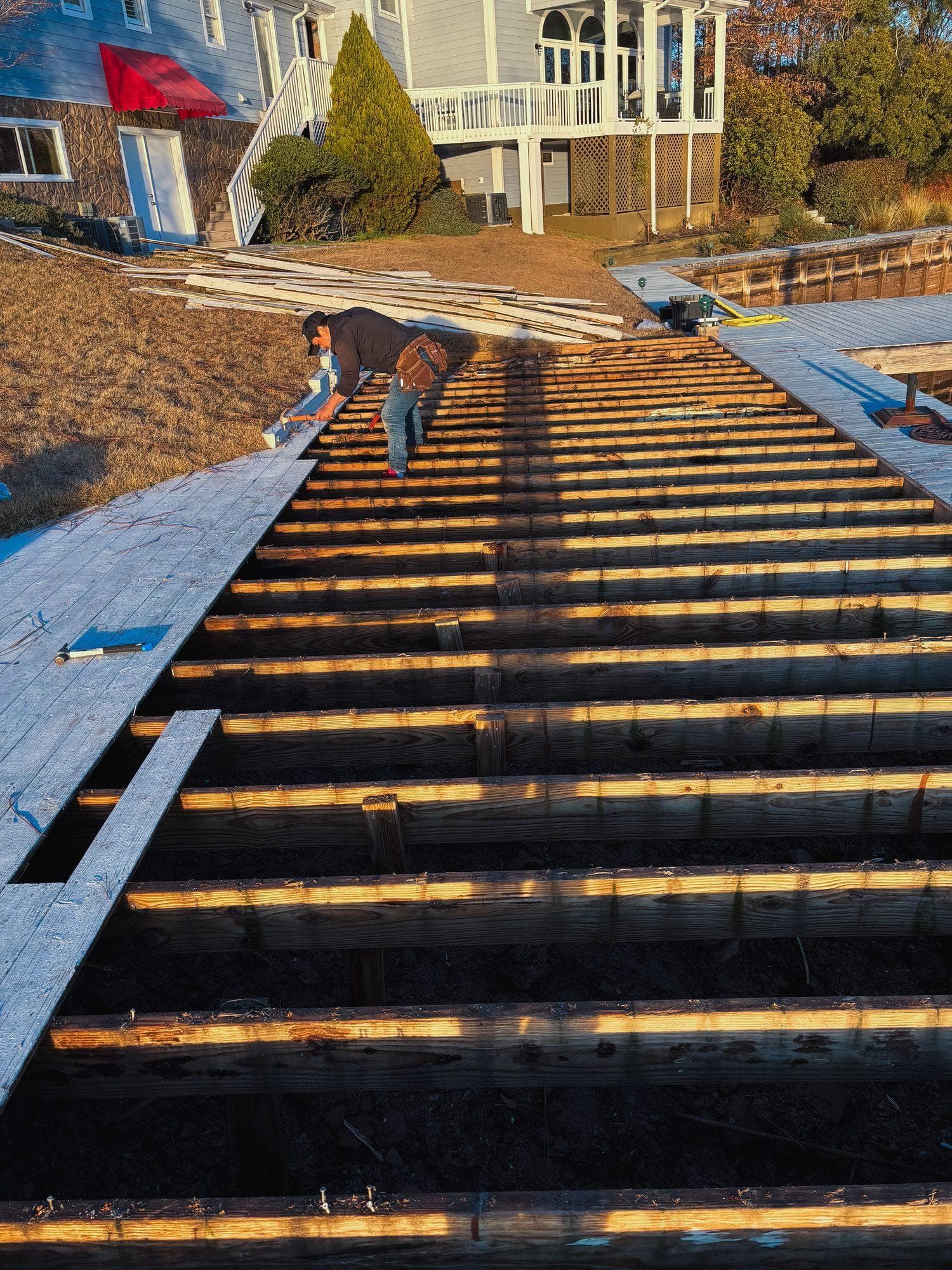
Boards, railings and stair treads are the parts you see and the cheapest to replace. The frame underneath (posts, beams, joists, the ledger bolted to the house, and the footings) decides repair or rebuild. New boards on failing joists is money spent twice.
| What you find | Usually | Why |
|---|---|---|
| A few soft or split deck boards | Repair | Boards swap out one at a time |
| Wobbly railing posts, loose balusters | Repair | Posts can be re-bolted or replaced and blocked |
| Rusted joist hangers or nails, joists still firm | Repair | Hangers and fasteners can be replaced |
| Soft ends on one or two joists | Repair | Sister or replace the joist, treat the cut ends |
| Ledger soft, no flashing, or nailed only | Replace (or rebuild the frame) | The house connection is the most common failure point |
| Many joists soft, sagging beam, sinking posts | Replace | The structure has reached the end of its life |
| Railing under 36 in. or gaps that pass a 4 in. ball | Rebuild railing at least | Current code minimums |
How to inspect your deck in 20 minutes
Take a flat screwdriver and a flashlight, and look from underneath too. Sound treated pine resists a screwdriver pushed by hand; rotten wood lets it sink in.
- Soft wood: probe board ends, the tops of joists under the boards, post bases and anywhere leaves collect. Rot starts where water sits.
- Ledger board: this is the board bolted to the house. The American Wood Council's DCA 6 guide calls for ½ in. lag screws or bolts into the house band joist, corrosion-resistant flashing over it, and no attachment to brick veneer. Look for rust streaks, gaps and soft wood.
- Joist hangers: the metal brackets that hold each joist. Look for flaking rust, missing nails, or hangers that were never nailed at all. DCA 6 calls for hangers at least 60% of the joist depth.
- Posts and footings: posts should sit on concrete footings, not buried in dirt. DCA 6 has footings bearing on undisturbed soil at least 12 in. below grade. A post that has sunk, leans or is soft at the bottom is a structural repair.
- Railing: grab each post and push hard. It should not move. Decks more than 30 in. above grade need a guard, 36 in. is the usual residential minimum height, and a 4 in. ball should not pass between balusters.
- Stairs: check stringers at the ground and at the deck, cracked treads, and a solid handrail.
Why treated pine decks fail in Lee County
Most decks around Auburn and Opelika are Southern yellow pine, pressure-treated with copper-based preservatives. It lasts well, but our long hot, humid summers mean the wood rarely dries out fully, especially on low decks, shady lots and anything close to the ground. Boards check (crack along the grain), water gets in, and the less-treated core decays.
Two details explain most early failures. Treatment level: the American Wood Protection Association rates deck boards and railings for above-ground use, but posts, and joists or beams that are hard to replace or near the ground, should be ground-contact rated (UC4A). Cut ends: every saw cut exposes less-treated wood, and the industry standard calls for brushing copper naphthenate on cuts and drilled holes.
Fasteners matter too. Modern ACQ and copper azole treatments are more corrosive to steel than the old CCA. Simpson Strong-Tie recommends hot-dip galvanized or ZMAX (G185) connectors, or stainless steel for higher exposure, and DCA 6 requires fasteners and connectors to be galvanized or stainless. Plain steel nails in treated wood can rust through while the wood looks fine.
What deck repair and replacement cost
Repairs are priced per job after we look at the frame, because hidden rot changes the scope. The replacement figures are national averages from Zonda's 2025 Cost vs. Value Report, not our price list; local prices depend on size, height, stairs and railing.
| Work | Typical cost | Source |
|---|---|---|
| Board, railing, stair and hanger repairs | From $350 · most repairs $500–$5,000 | Z Construction repair range |
| New 16 x 20 ft deck, treated wood | $18,263 (about 95% recouped at resale) | Zonda 2025, national average |
| New 16 x 20 ft deck, composite | $25,096 (about 89% recouped at resale) | Zonda 2025, national average |
When repair makes sense, and when replacement wins
- Repair: the joists and posts are firm, the ledger is bolted and flashed, and the problems are in the top layer.
- Repair: an inspection item before a sale. We document the work with photos for your agent.
- Repair and re-deck: the frame is sound but the boards are worn out. New boards (treated or composite) on a good frame is a solid middle option.
- Replace: the ledger is rotten, nailed or attached through brick veneer, or several joists and posts are soft.
- Replace: you want a different size, height or a covered porch, permitted and built to current code.
Composite or pressure-treated for the new deck
Either way the frame is usually treated lumber; the choice is mostly about the boards and railing.
| Pressure-treated pine | Composite boards | |
|---|---|---|
| Upfront cost | Lower | Higher (Zonda: about 37% more nationally) |
| Upkeep | Clean and re-seal or stain on a schedule | Wash; no staining |
| Heat | Stays cooler in sun | Some colors get hot in July sun |
| Our humidity | Checks and can rot if neglected | Boards don't rot, but the frame still can |
Permits for deck work in Auburn and Opelika
New decks and deck rebuilds need a building permit in both cities: City of Auburn Inspection Services on N. Ross St., and the City of Opelika Building Inspection Division through Public Works. Swapping a few boards is typically treated as a minor repair, but replacing a ledger, joists, posts or stairs is structural work, and we confirm with the City before we start. Outside city limits, Lee County issues permits. Our permit guide explains each office, and HOA approval is separate if you change the deck's size, color or railing.
Sealing and staining schedule
- New treated wood: wait until it is dry enough to absorb water. Viance, a preservative maker, says treated wood is typically ready about 60 days after installation; sprinkle a few drops of water, and if they soak in, it is ready.
- Clear water repellents: Viance notes most makers recommend a yearly coat.
- Semi-transparent stains: plan on recoating the floor every couple of years and railings less often; follow the product's label.
- Timing: in Lee County, fall is the best window. Clean after pollen season in March and April, and avoid staining in direct July sun. See our exterior painting timing guide for the same weather logic.
Get a written price for home repairs & carpentry
A free walkthrough, a line-by-line estimate in writing, and the owner on the job from start to finish.
Typical 2026 range in Lee County: From $350 · most repairs $500–$5,000
Or just leave your number
The owner calls or texts you back, usually the same business day. No spam, no mailing list.
FAQ
How do I know if my deck is safe?
Check that the ledger is bolted and flashed, the posts sit on footings, joists and hangers are firm and rust-free, and the railing doesn't move when pushed. If any fail, stay off it until it is looked at.
How much does deck repair cost in Auburn, AL?
Most board, railing, stair and hanger repairs fall in our repair range: From $350 · most repairs $500–$5,000. Structural repairs to the ledger or frame are priced after an inspection, with a written scope.
Can I put new boards on my old deck frame?
Yes, if the frame passes inspection. We replace any bad joists before new boards go on. Composite boards may need tighter joist spacing than your old frame has.
Do I need a permit to replace my deck in Opelika or Auburn?
Yes, a replacement deck needs a building permit in both cities. We pull it and schedule the inspections.
Is composite decking worth it in our climate?
It is if you don't want to stain every few years and plan to stay a while. It costs more upfront, and the frame underneath still needs the same care as a wood deck.
Sources
- American Wood Council — DCA 6, Prescriptive Residential Wood Deck Construction Guide (2015 IRC)
- American Wood Protection Association — Use Category guide for residential treated wood
- Simpson Strong-Tie — Preservative-Treated Wood FAQ (connector corrosion)
- Viance (TreatedWood.com) — Staining treated wood
- Zonda — 2025 Cost vs. Value Report